Christine looked grave and weary.
C: “I’m almost ready for my Bar Mitzvah.”
G: “No, dear friend. You are not.”
C: “I guess we can continue where we left off yesterday.”
M: “Gerald has further info on the Iranian Constitution, yes… no? I have nothing like yesterday, and you yourself, Christine?”
C: “Am trying in vain to construe a picture of the Zionist landscape. Jews are the most heterogeneous group I can imagine. I don’t even know where to begin.”
G: “Then let me start with a theory: Jews are acutely aware that unless they have a country of their own, pogroms and the Shoah can happen again. But they don’t know why.
In fact, I don’t think the Jews ever understood what was the engine that drove Holocaust, likely because we do not either. Much in the same way that victimised women don’t understand a man’s urges — similarly because largely he doesn’t himself either. All Jews, Nazis, women or men know are pathetically reduced vocabularies that are unable to express anything at all.
So in essence the Jews fear that Holocaust can happen again. And now that we are at it, what did become of anti-semitism? Where did all the pogroms go? One minute the trains are packed with human beings driven to slaughter, the next, silence.”
C: “Or is there silence? Israeli writers disagree starkly.”
M: “It matters, since the Jewish ideological life is just as multi-dimensional as Western philosophy.”
C: “I have ordered several books on Judaism from my library. Just getting a foothold in the endless list of denominations is a staggering job.”
G: “You know what strikes me as the strangest part of it all? How Jewish identity revolves around a past that we share. It’s like they have to compete with us for their own past. In that sense we are the Muscovites insisting on descending from Kievan Rus and the Jews are the Ukrainians insisting they are the real descendants. Our scholars speak Hebrew as well as they do. Their mysteries are in lockstep with our mysteries.
Historically this is alluded to in that Judaism fractures and is transformed in tandem with the rest of the world. Do Hasidic Jews in the 1700s share disposition with German Pietism or with Unitas Fratrum?”
M: “Secularisation forced upon French Jews after the French Revolution started modernity’s influence. It would have been unstoppable anyway.”
C: “And then there is Zionism, which was not so obvious after all. I admit that I have investigated the subject with an eye to Zionism, and now I regret that. It’s difficult to figure out if Jews are politics first or religion first. The two seem intertwined, even when they are anti-Zionist.”
M: “Accepting being a diaspora is a political act as well.”
C: “As usual when we are dealing with politics, every position people can hold can make a whole lot of sense when you read the argument. And far worse, I feel I am steeped in a mix of atheistic refutation of all things mystical and the outright occult!”
M: “Frankly, we are being swept away here. We need to read slowly and develop a language that makes us able to put opposing sides next to each other.”
G: “May I suggest that we instead confuse ourselves tonight. Tomorrow we can try to make heads and tails of tonight’s discussion.
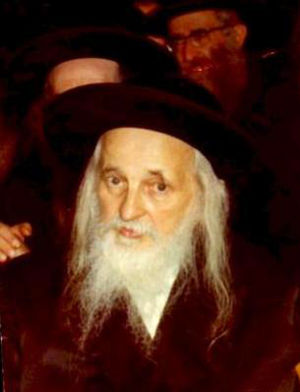
Joel Teitelbaum
Okay, so allow me to zoom in on Joel Teitelbaum who comes from a line of Hasidic rabbis. His great grandfather was Moshe Teitelbaum, a disciple of Yaakov Yitzchak of Lublin, “the Seer of Lublin”. This great grandfather moved to Hungary and spread his mentor’s Chasidic school there.”
C: “… Sounds more interesting than Joel?”
G: “Joel continued the conservative Chasidic line which was originally in opposition to the Jewish Enlightenment, Haskalah or wisdom, and later Joel himself was in opposition to Zionism.
If you think about it, it makes a kind of sense. Jews in Poland were in no good position in the 1700s. In fact, neither was Poland. In the 1600s Poland had its wars with Sweden and Russia resulting in poverty and a weak economy and government. The resulting persecution of Jews drove those to seek comfort in new mysticism such as Lurianic Kabbalah. The continued persecutions in 1700s Poland evolved Kabbalah to the Chasidim movement.
Making sense of living in unchallengeable conditions is what creates dogma.”
M: “Hardly anybody today would call Kabbalah dogma…”
G: “I agree with Durant: It was pure escapism. The Jews could not take the reins of their fate so they invented a drug to make its endurance tolerable.”
C: “With those words you set the stage for a radical reinterpretation to come later.”
G: “That reinterpretation did come. Anyway, the Chasidim becomes one kind of Orthodox Judaism with these anti-modernist traits.”
C: “And this is where our friend, Joel Teitelbaum, enters the picture. He reminds us of the Three Oaths:”
a) Israel should not return to the Land together by using force; b) Israel should not rebel against the nations (i.e., non-Jewish peoples); and c) the nations (i.e., non-Jews) should not subjugate Israel “too harshly.”
Teitelbaum … views the establishment of the State of Israel as an act of “impatience,” echoing the Talmud’s warning about the dangers of seeking God’s love with impatience.
C: “Within Judaism the change from being passive to actively seeking the creation and continuation of a state is halakhic challenge.”

Abraham Kook
G: “It is taken up with full force by the likes of Abraham Isaac Kook, who sees Zionism as a necessary transgression. By following their political instinct, the advocates drive the Big Guy’s plan forward, even by sinning according to the old halakhah.”
M: “Transgression is an open term as well. The Old Testament lacks nothing in the department of Jewish imperialism either. The Canaanites can attest to that.”
C: “I know. This Promised Land goes from holy grail to political reality to holy grail again to symbolic hope to political reality once again.”
G: “Imagine our political reality and independence depends on a bedtime story.”
They looked at each other and at the screens. Christine was trying to read Hebrew.
/ПРИЗРАК