Their cellphones gave a beep when the clock passed midnight. Unnoticed hours had come and gone swimming in this vast ocean of enlightened opinions and agitations. The sound made them realise they could spend weeks like this.
“What are we honestly doing?”, asked Maurice.
“Betting on peace”, replied Benedict.
“Should we change tactics for a second? Looking for a single politician with a microphone stating that the enemy is not completely unreasonable doesn’t sound very productive.”
“I need to confirm that there is some kind of hope. It is glaringly obvious that we as a species are prone to be spellbound by our views. Perhaps because they are correct. Perhaps all the theories are connect, Marxism, liberalism, conservatism, anything.”
“What if there is a little bit of truth in each?”
Benedict replied immediately: “The statement that has a little truth to it must necessarily also be mostly a lie.”
“A viewpoint is not a mathematical proof. It is a mental habitation, a place for one’s hopes and dreams to hibernate when the cold sets in.
Speaking of hibernation, I’m beat for tonight. Could we at the very least continue tomorrow?”
His friend was already nodding, but managed to stumble out the door.
The next morning Maurice welcomed him again and gave his opening statement:
“National self determination… will it give purpose to life?
I was reading this morning on the history of Ukraine. Andriy Parubiy, when opening the plenary meeting 05.09.2017 mentioned Mykhailo Hrushevsky, the historian. This figure means a lot for the formation of Ukrainian self-identity. He wrote a history that connected present day Ukraine with ancient Kievan Rus.
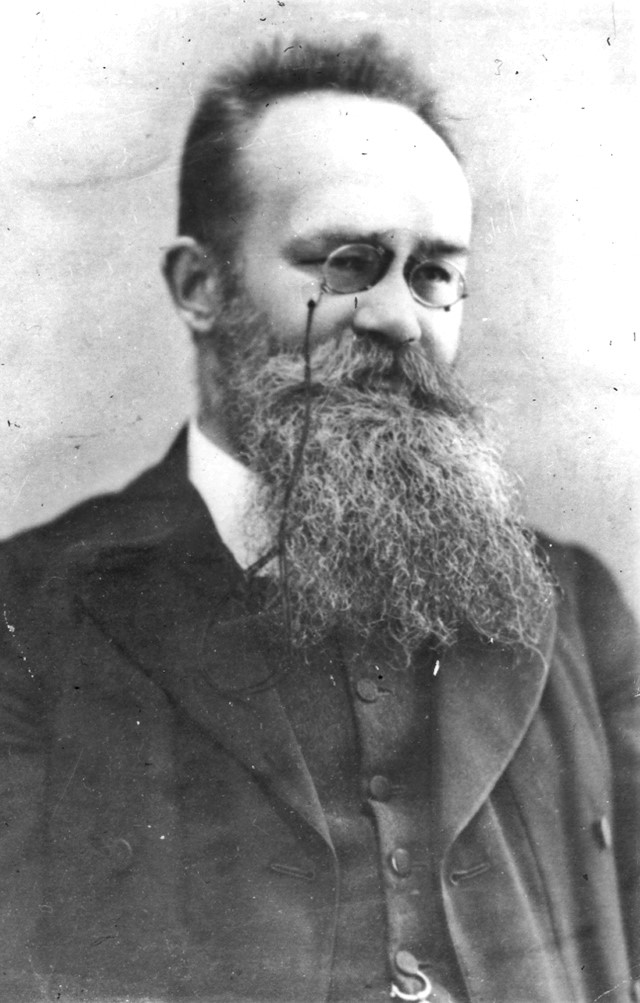
Mykhailo Hrushevsky
He was the first head of the Central Rada in 1917. It happened during the Ukrainian Revolution (which is frankly no less complex than the Russian revolution). That resulted in the Rada coming into existence and also an upsurge of movements to fill the power vacuum after the end of the Russian and Hapsburg Empires.”
“I know some of this history”, Benedict chimed in. “In reality these movements could neither hold on to power nor actually unite the people behind the idea. It was just too early in history for that. Peasants wanted land, not national unity.”
“But now, this early quest for statehood is a national symbol. You have to learn to be a Ukrainian, an American, a European.”
“I know what you are thinking: Isn’t nationalism just another sect? Some are inside, and they try to convert the rest.”
“Identity, the meaning of life. Having one’s own identity. Ironically though, it must be a shared identity.
But it is something else, that bothers me… Where does individualism fit into this? Mykhailo Hrushevsky may have given Ukraine a place in history, but what about himself? He was against the Hetman Skoropadsky’s social conservatism. He disagreed with the anti-hetman Directory, he became inclined toward Bolshevism. Like all true intellectuals, his brain couldn’t allow for settlement anywhere. He had to define the world.”
Benedict was pondering for a while. “You, Maurice? Promulgating mysticism?”
“Yes! We are all guided by invisible beings that we call ideas, are we not? The nationalists are guided by a strange, ever-changing amalgam of ideas which belongs to and is evolved by the culture. But also invented by people like Hrushevsky. But what guided him? Something else, right?”
Benedict started pacing back and forth. His face was pondering, and so was his brain.
“Dreaming of a nation when you don’t have one is simply dreaming about a way to protect yourself. Dreaming of a bigger nation once you have one is a growing appetite.”
“Is that supposed to be Ukraine? Now I will have to disagree. Look at the Rada discussions at plenary meetings. They want a safer and more prosperous country. Russia wants to expand.”
“No, look again. They all say the same thing, Ukraine, Russia, USA, Israel: »We can only be safe if our borders are strong.« Yes, Russia wants to expand its borders. Israel does too. They want to move them to an easily defensible position. In Russia’s case it is too complicated, since there is no natural demarcation of where the West ends and where the East begins.”
“Isn’t it safe to say that what can theoretically start as a ‘defensive’ expansion, can easily slip and become outright cruel ambition?”
“Sure. What starts as »Nobody will protect us, we must protect ourselves«” when talked about and written about enough can easily morph into »This is our shared dream, our mutual destiny: A whole country, given to us by our own God.«"
“I still fail to see why you fail to see the circumstances here: Civilised nations can talk their way out of disagreements, autocratic nations with insane leaders cannot. They resort to violence.”
“And all Western nations only resort to self defence? We need NATO as a strong protection against wanton violence perpetrated by maniacs beyond ethical reach?”
“History shows …”
“We have time machines. They are called books. But you miss a bigger point: Earth is a room full of people large enough that it reaches critical mass and fissions. The cultural clusters does not seem to coexist peacefully. They distrust each other.”
“That at least is a lie. The western countries can coexist peacefully. That is a true political and ideological success story.”
“Can we coexist if we become different enough? Experiment: Let the newsmedia start to demonise a neighbouring country. What would happen? Let’s assume even a very small difference.”
“So not something like Christian versus Muslim or even Catholic versus Protestant?”
“No. Still value-related, but contrived, freshly created values for this experiment.”
Benedict was trying to come up with an example for a while. Difficult indeed. Maurice stepped in:
“Let’s say the news started to talk constantly about length of a work day. Country A has 9 hours, country B has 7 hours on average. Then …”
“… It begins with a small incident. The closing of a factory in country A. Some time is spent in the news media on analysing why. An image of a hard working A-people emerges. Conclusion: Not our fault. Global economy. Camera cuts to the streets where another journalist stands ready, saying:
» The economy of Europe is being actively discussed in the EU parliament as it relates to working day length. Some countries still have less than 8 hours, which is recognised as a major contributing factor to a downward spiral.«
All the rhetorical devices present. Reference to (imaginary) authority etc. Yes, that would work.”
“Next time work day length is brought up, people starts to catch on. A recurrent theme. A real problem exists in Europe.”
“Once we start to differentiate between hard working and lazy countries - something all people who work can relate to - the phenomenon flips over. Now whenever a business failure is mentioned, and the media does not refer to the crisis in work ethic amongst some countries affecting the entire economy on the continent, anger will ensue. Angry victims demand that the truth be told, that their misery is the end result of those rotten apples, those lazy B-people.”
“Still a long way from war.”
“Yes. Very long. But let’s add in a couple of government funded agencies to promote these ideas over several decades. Let’s add a mutual and perceived government fear that the other country desire to uproot this country’s labour market model. If further large cultural shifts occur in both countries challenging the old value systems, and massive psychological operations pointing the finger at bad influence from the other side of the border… I don’t think war is that far away after all.”
“Okay, enough about that. This is exactly why we need absolute measurements, a standard to which all people can be held.”
“No, you want an ideology to end all ideologies. You can’t have that. But we can do something else. We can roll back time and take another look at how things transpired. If we see the signs of the example we have just put forth, then we now that the war resulted from pockets of steam building up in all the wrong places.”
“Okay then. I’m curious too. Strange thing with diaries. We have the luxury of hindsight. But a diary is full of the unknown.”
Maurice and Benedict went to the shed in the garden. The porch was cleared and a table and a couple of chairs was put in place. Since last night, Maurice had done some setting up of computer screens and cables. A nice working place for a whole day of arduous research.
/PARADOX