6th June
Discovering Goebbels’ articles in Der Angriff yesterday unlocked a vast ocean of insight.
Perhaps I afforded myself the unethical luxury of pretending that everything after 1930 was unknown and unwritten. No crimes against humanity had yet been perpetrated. No power grab had upended the internal balance and let loose a river of pent up hate. No hearts were turned to stone.
What I found in a young Goebbels was not a propaganda mastermind. At least not yet. His authentic and passionate impulses had not yet been reduced to being a tool, a trick in the employment of mass manipulation.
They were still brothers in arms, and his affections were still genuine.
It may be a trick, but why? I don’t see the necessity for that explanation, except in us wanting to attribute verdächtige Motive to a man who we identify with evil.
The problem is that we avoid the most damning of human aspects: Love can turn to hate.
The liberal solution is to reduce love to a parlour game. But that is a divorce from human nature. Until we resolve the fundamental problem, we as a civilisation have nothing on which to build a stable society.
First I need to unlock the hopes and longings of the movement.
A Eulogy
Der Angriff is a treasure trove in that regard. A random pick and a hunch lead me to another article on the death of a man called Horst.
Die Fahne Hoch!
An einem späten Abend: der seltene Genuss der ungestörten Lektüre eines guten Buches. Voll Beseligung atmet man Frieden und Entspanntheit in sich hinein. Da klingelt mitten in der Stille das Telefon. Voll banger Ahnung nimmt man der Hörer von der Gabel. Es ist furchtbarer, als man erwarten konnte: “Horst Wessel ist soeben niedergeschossen worden.” Zitternd von innerem Grauen die bange frage: “Tot?” “Nein aber wohl hoffnungslos!” Nun werden die Wände eng, und die Decke droht niederzustürzen. Aber dann bäumt sich alles auf gegen das Unfaßbare. Das kann nicht sein!
Raise the flag!
Late one evening: the rare pleasure of undisturbed reading of a good book. Full of bliss, you breathe in peace and relaxation. Then, in the middle of the silence, the phone rings. Full of apprehension, you pick up the receiver. It’s more horrific than you could have expected: “Horst Wessel has just been shot.” Trembling with inner horror, the anxious question: “Dead?” “No, but certainly hopeless!” Now the walls are closing in, and the ceiling threatens to collapse. But then everything rebels against the incomprehensible. This can’t be!
I will do something which probably is not usual: Opting to believe he is sincere.
I know the dread he is talking about, the looming fear that soon the dam will break and calamity will strike. Already the great dark hand is searching for the weakest link to crave as a victim. Who dies? Always the best, the most innocent, the ones we would give anything to keep out of harm’s way.
And now reality has grabbed you with mighty claws and it squeezes you between its powerful fangs. You can wait by a hospital bed. Only wait.
Ein paar Tage später. Ich trete in dieses schmale Krankenzimmer zu ebener Erde und schreckte zurück vor diesem unerträglichen Anblick. Wir hat die Kugel in dem seinen Kopf dieses heldenhaften Jungen gewütet.
Sein Gesicht ist entstellt. Ich kenne ihn kaum wieder. Er aber ist eitel Freude und Glück. Seine hellen, klaren Augen leuchten auf; wir können nicht viel reden. Der Arzt hat ihm jede Aufregung verboten. Er sagt nur immer wieder die paar Worte: “Ich freue mich.” Er brauchte das gar nicht zu sagen. Denn man sieht es ihm gleich. Unter Blut und Wunden ein junges, leuchtendes Lächeln. Er glaubt noch.
Ich saß dann einen Sonntagnachmittag an seinem Bett, als der Schwarm der Besucher sich verlaufen hatte und die weiche Dämmerung langsam durch die hohen Fenster kam. Man durfte wieder hoffen. Es ging aufwärts; das Fieber war gesunken, die Wunden heilten. Er saß halb aufrecht und erzählte. Wovon? Dumme frage! Von uns, von der Bewegung, von seinen Kameraden. Sie waren am Nachmittag draußen vor der Tür gestanden und dann einer nach dem anderen vorbeigegangen, mit erhobenem Arm, um ihren jungen Sturmführer einen Augenblick zu sehen und zu grüßen. “Ohne das wäre es nicht zu ertragen!”
A few days later. I enter this narrow hospital room on the ground floor and recoil at this unbearable sight. The bullet has raged in the head of this heroic boy.
His face is disfigured. I hardly recognize him. But he is full of joy and happiness. His bright, clear eyes shine; we can’t talk much. The doctor has forbidden him any excitement. He just keeps repeating the few words: “I’m happy.” He doesn’t even need to say it. Because you can see it right away. Beneath the blood and wounds, a young, radiant smile. He still believes.
I sat by his bed one Sunday afternoon, when the swarm of visitors had dispersed and the soft twilight slowly crept through the high windows. There was hope again. Things were looking up; his fever had broken, his wounds were healing. He sat half-upright and talked. About what? Stupid question! About us, about the movement, about his comrades. They had stood outside the door that afternoon and then walked past one by one, arms raised, to see and greet their young Sturmführer for a moment. “Without that, it would be unbearable!”
History is moved by giant pendulums setting each other in motion.
To us someone else dying in a hospital does not signify much. We think: “We all die, but most of us don’t evolve into mass murderers over that.”
But that is wilful blindness to the forces of history, which are really not much different from oceanography, only the sea is human.
All that the wheels of history require is a vow and a decision.
Ich schaue auf seine Hände, die nun ganz schmal und weiß geworden sind. Mitten in diesem hageren Gesicht steht scharf und gebieterisch die Nase, darüber funkeln zwei helle Augen. Schon im Fieber? Er kann nicht essen; seine Kräfte nehmen zusehends ab, aber der Geist is frisch und regsam. Lesen darf er nicht. Nur erzählen, erzählen. Es fällt schwer, dem mahnenden Wink der Schwester Folge zu leisten. Werde ich ihn noch einmal sehen? Wer weiß! Wenn keine Blutvergiftung hinzukommt, wird alles gut gehen.
Draußen im Garten steht eine einsame Mutter. Ihr Blick ist eine einzige große Frage. “Wird er’s schaffen?” Was soll man anders sagen als ja. Man redet es sich selbst und anderen ein.
Die Blutvergiftung kam. Am Donnerstag ist man sich klar, daß nur noch geringe Hoffnung besteht. Er möchte mich sprechen.
I look at his hands, which have now become thin and white. In the center of his gaunt face stands his nose, sharp and commanding, above which sparkle two bright eyes. Has he already developed a fever? He can’t eat; his strength is visibly declining, but his mind is fresh and alert. He’s not allowed to read. He can only talk and talk. It’s difficult to heed the nurse’s warning. Will I see him again? Who knows! If he doesn’t develop blood poisoning, everything will be fine.
Outside in the garden stands a lonely mother. Her gaze is filled with one big question. “Will he make it?” What else can you say but yes? You tell yourself and others that you’re right.
The blood poisoning set in. By Thursday, it’s clear that there’s only a small amount of hope left. He wants to talk to me.
Everybody who has ever lived through those dark nights are marked for life. Nights where all you could do was pray and hope that death would not touch the subtle and gentle fabric of friendship, camaraderie or family ties.
Such nights become life changing experiences.
Who is Goebbels? At the time of Horst Wessel’s murder he was 33 years old, I believe. He is no longer a young, naive man, but not necessarily completely blackened inside by age either. Horst was ten years his junior, close enough that he could perhaps see something of himself in the younger vivacious Sturmführer, leader of his comrades.
Take a look at this picture:
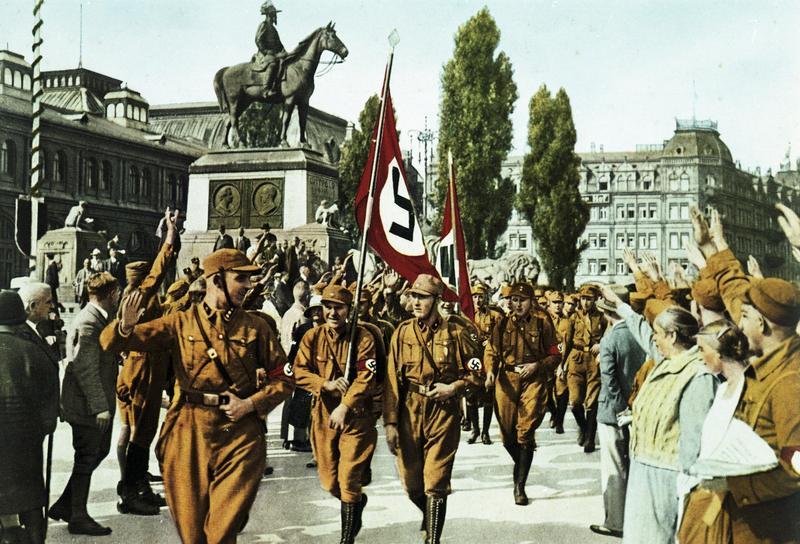
Laughter and high spirits.
What do you and I know about salvaging the spirit of youth out of a world war and subsequent economic depression? In Germany in the late 1920’s this was the form it took.
The real question is of course, what are the surrounding people thinking? Old workers and pensioners. Ordinary people making ends meet.
I need to know this, because as eager as my contemporaries are to identify the next Hitler, we aren’t really savvy at spotting the driving forces. Well, and also the fact that the entrance door to the movie theatre with all its flashy embellishments rarely resembles the exit door leading into a dirty alley. If I want in, this is what I should be reading.
Auf einen Augenblick erlaubt es der Arzt. Wir schwer geht der Schritt über diese schmale Schwelle, vor der schon der Tod Wache hält!
Er weiß noch nicht vom Ernst seines Zustandes. Aber als ahnte er dumpf, daß es das letztemal sei: “Gehen Sie nicht weg!” bettelt er. Und die Schwester gibt nach; es beruhigt ihn. “Sie dürfen nicht den Mut verlieren. Das Fieber geht auf und ab.
Auch die Bewegung lag zwei Jahre im Fieber, und trotzdem ist sie heute stark, und gesund.” Das tröstet ihn. “Wiederkommen!” flehen seine Augen, seine Hände, seine heißen, trockenen Lippen, als ich schweren Herzens gehen muß.
For a moment, the doctor allows it. How difficult it is to step over this narrow threshold, before which death already stands guard!
He doesn’t yet know the seriousness of his condition. But as if he vaguely sensed that this would be the last time: “Don’t go away!” he begs. And the nurse relents; it calms him. “You mustn’t lose heart. The fever goes up and down.
My movement, too, was feverish for two years, and yet today it is strong and healthy.” That comforts him. “Come back!” his eyes, his hands, his hot, dry lips plead as I must leave with a heavy heart.
Interjection: Searching for Goebbel’s diaries online (sadly the full archive is not free), I found several texts on Holocaust denier’s webpages.
Holocaust denial. To me it sounds like a double insult, obviously to the Jews who acquired an everlasting collective trauma. But also to the nazis themselves. We deny them the historical fact that what they did, they did for reasons. We bury both the events and the reasons.
But similarly we inflict grave injury to history when we attempt to attribute the events to the puny psychological traits of a few individuals. Typical examples are when journalists label Goebbels vain and insecure or lavish medical diagnoses on Hitler who was doomed to spend his life compensating for a bad career as an architect.
But neither Hitler nor Goebbels were fiascos. They were tremendous successes, just not at something we admire or respect. We just have a tendency to ignore that being a politician is a cursus honorum too which one can excel at.
Unlocking nazism means understanding what happens when you suspend an entire people into a social force field while their worries are soaring. A strong repellant driving them away from poverty, despair, dissolution and a strong current sucking them into another reality.
This is key.
Eine dumpfe Ahnung sagt mir, daß es ein Abschied für immer ist.
A vague premonition tells me that this is a farewell forever.
Goebbels as a vain little man spending a life overcompensating for his inabilities? Who will that verdict please most? Us or the truth?
1930 was as real as 1920. The difference is that every event, every obstacle, every hindrance, and every pain gave these people further direction, further resolve.
What are we afraid of? That love breeds hate?
For a century we have shied away from love of any kind, fearing a repetition of the worst social calamity in human history. Our affections are amputated. Movements invoking feelings of dedication and affection have been looked at suspiciously ever since.
Not that emotion and love takes a movement. But for some reason cynicism became the panacea.
I am not saying that the Reich wasn’t populated by brutish, callous people too. But somewhere on the continuum between love and hate, they populate a rather small group on the far end.
It takes a democracy and a process of mass legitimisation to give such people actual power.
Sonnabend früh. Sein Zustand ist hoffnungslos. Der Arzt gestattet keinen Besuch mehr. Der Todwunde rast in Fieberphantasien. Er erkennt schon seine eigene Mutter nicht mehr.
Sonntag früh um halb sieben Uhr gibt er nach schwerem Kampf seinen Geist auf. Als ich nach zwei Stunden an seinem Totenbett stehe, kann ich gar nicht glauben, daß das Horst Wessel ist. Sein Gesicht ist wachsgelb, die Wunden sind noch verdeckt mit weißem Verband. Schwarz stehen auf dem schmalen Kinn die Stoppeln. Die Augen sind halb offen und starren gläsern ins Leere: in die Unendlichkeit, die noch vor uns allen droht. Mitten unter Blumen weißen, roten Tulpen und Veilchen, liegen schmal und kalt die müden Hände.
Saturday morning. His condition is hopeless. The doctor no longer allows visitors. The man, who is mortally wounded, is raving in feverish fantasies. He no longer recognizes his own mother.
At 6:30 a.m. on Sunday morning, after a difficult battle, he gave up the ghost. As I stand at his deathbed two hours later, I can’t believe it’s Horst Wessel. His face is waxy yellow, the wounds still covered with white bandages. The stubble stands out black on his narrow chin. His eyes are half-open, staring glassily into the void: into the infinity that still looms before us all. Amidst the flowers of white and red tulips and violets, his thin, cold hands lie.
Now for a moment, we can afford the luxury of forgetting these were nazis. In fact, had I been given the entire text redacted in a very few places so I would not know its origins, I would have read it as a script for a few scenes in a movie written by a sensitive author aware of the vicissitudes of life and death.
Horst Wessel ist hinübergegangen. Nach Kampf und Streit liegt hier stumm und regungslos das, was sterblich an ihm war. Aber, ich fühle es fast körperlich sicher, sein Geist stieg auf, um mit uns allen weiterzuleben. Er hat es selbst geglaubt und gewußt; er gab dem hinreißenden Ausdruck: er “marschiert in unseren Reihen mit!”
Wenn später einmal in einem deutschen Deutschland Arbeiter und Studenten zusammenmarschieren, dann werden sie sein Lied singen, und er wird mitten unter ihnen sein. Er schrieb es hin in einem Rausch, in einer Eingebung, wie aus einem Guß, dieses Lied, das aus dem Leben geboren ward und dazu, wieder Leben zu zeugen.
Schon singen es landauf, landab die braunen Soldaten. In zehn Jahren werden es die Kinder in den Schulen, die Arbeiter in den Fabriken, die Soldaten auf den Landstraßen singen. Sein Lied macht ihn unsterblich! So hat er gelebt, so ist er dahingegangen. Ein Wanderer zwischen zwei Welten; zwischen dem Gestern und dem Morgen, dem Gewesenen und dem Kommenden. Ein Soldat der deutschen Revolution! Wie er so manchmal, die Hand am Gurt, stolz und aufrecht, mit dem Lachen der Jugend auf den roten Lippen seinen Kameraden voranschritt, immer beret, sein Leben einzusetzen, so wird er mitten unter uns bleiben.
Horst Wessel has passed away. After battle and strife, what was mortal in him lies here, silent and motionless. But, I feel it almost physically certain, his spirit rose to live on with us all. He believed and knew it himself; he gave it the captivating expression: he “marches in our ranks!”
When workers and students march together in a German-speaking Germany one day, they will sing his song, and he will be among them. He wrote it in a frenzy, in inspiration, as if cast from a single mold, this song that was born of life and meant to engender life again.
The brown soldiers are already singing it up and down the country. In ten years, the children in the schools, the workers in the factories, the soldiers on the highways will sing it. His song makes him immortal! This is how he lived, this is how he passed away. A wanderer between two worlds: between yesterday and tomorrow, between what was and what is to come. A soldier of the German Revolution! Just as he sometimes strode ahead of his comrades, his hand on his belt, proud and upright, with the laughter of youth on his red lips, always ready to risk his life, so he will remain among us.
My own feelings as a human?
There is a stark difference between standing next to the physical body of someone you empathise with, and writing about him late in the evening.
The inflection point where Goebbels moulds something new — even just to make sense of Horst Wessel’s death — out of something real and painful is both honest and deceitful. Equally so and equally necessary.
But here we see the devious face of sorrow: We reason. Lifted by the bloody hands of fate out into the wilderness of unspoken beastly nature, we salvage ourselves by grafting us back into reality.
Goebbels now commits the only real sin in his career: He concocts and fabricates a system. He seizes the angel by his soft, bloodied wings and tries to steer him into his fold.
“I lost my son, I loved him more than anything.”
“Go on, the gods are listening.”
“He walks with us in our society. Let us build this community for martyrs like him.”
And the gods turn their blind eyes to the human race once again. And darkness shall cover the earth.
The human animal march together.
Ich sehe im Geiste Kolonnen marschieren, endlos, endlos. Ein gedemütigtes Volk steht auf and setzt sich in Bewegung. Das erwachende Deutschland fordert sein Recht: Freiheit und Brot!
Hinter den Standarten marschiert er mit, in Schritt und Tritt. Vielleicht kennen ihn dann die Kameraden nicht mehr wieder. Viele gingen dahin, wo er jetzt ist. Neue kamen und kamen.
Er aber schreitet stumm und wissend mit. Die Banner wehen, die Trommeln dröhnen, die Pfeifen jubilieren; und aus Millionen Kehlen klingt es auf, das Lied der deutschen Revolution:
“Die Fahne hoch!”
- Februar 1930.
In my mind, I see columns marching, endlessly, endlessly. A humiliated people rises and sets out on the move. An awakening Germany demands its rights: freedom and bread!
He marches behind the standards, in step. Perhaps then his comrades won’t recognize him anymore. Many went to where he is now. New ones came and came.
But he marches along, silent and knowing. The banners wave, the drums boom, the fifes rejoice; and from millions of throats, the song of the German revolution resounds:
“Raise the flag!”
February 27, 1930.
But they march alone.
PARADISE LOST